
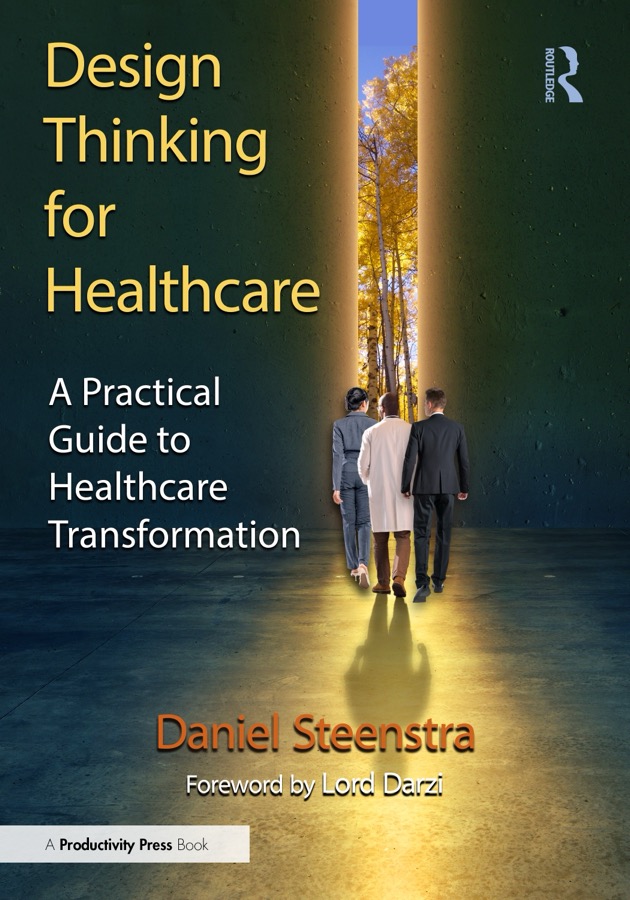
Design Thinking for Healthcare
A Practical Guide to Healthcare Transformation
Foreword by Lord Darzi
Routledge / Productivity Press · 5 October 2026
Healthcare transformation is failing. Decades of reform and billions in investment have left the $4.3 trillion US healthcare system and the NHS delivering declining outcomes, workforce burnout, and operational dysfunction. The programmes multiply. The results disappoint.
The human cost is tangible. Around the world, growing numbers of people are denied the healthcare they need — the knowledge and capability exist, but the systems meant to deliver care are too badly designed to reach them. That is a moral failure as much as a systemic one. It is the reason this book was written.
It is written for healthcare executives, clinical directors, policymakers, and innovation leaders driving — or struggling to drive — that change.
The clinical workforce transformation leaders are trying to engage already possesses the core capability they need. The diagnostic reasoning of good clinical practice — deep observation, iterative refinement, solutions fitted to the specific situation — mirrors the design process precisely. The challenge is unlocking what already exists and directing it systematically at the design of care systems, alongside the delivery of care.
Design Thinking for Healthcare provides the framework and the field manual to do this. Drawing on the author's combination of nine years of medical training, eleven years as a professional designer at Michelotti and Jaguar, and twenty-five years teaching design thinking to engineering and business leaders, it delivers a comprehensive guide spanning clinical trials, AI implementation, policy design, and organisational change.
Part IV diagnoses why transformation initiatives collapse — structural traps, political dynamics, and the institutional resistance that defeats even well-designed programmes. Part V goes further: practical tools, 90-day roadmaps, and a fully customised implementation field manual to begin transforming your organisation immediately.
Equitable, sustainable, effective healthcare is within reach. Here is how to build it.
Questions readers ask
Why does healthcare transformation fail so often?
Most programmes try to make the existing system more efficient. They seldom ask whether the system is designed to do the right job. Design Thinking for Healthcare (Routledge, 2026) explains the other reasons too: structural traps, political dynamics, and the institutional resistance that stops even well-designed programmes.
What is design thinking in healthcare?
Design thinking is a disciplined way to understand a problem before you solve it. You observe, define the real problem, develop options, test them on a small scale and refine them. Design Thinking for Healthcare applies this method to the design of care systems, not only to products and services.
Do clinicians already think like designers?
Yes. Diagnosis follows the same steps as the first half of the design process: gather evidence, then narrow it to the real problem. Treatment follows the second half: develop a plan, monitor the response, adjust. Design Thinking for Healthcare shows that this capability already exists in the clinical workforce, but organisations rarely use it to design the systems in which care is delivered.
How is design thinking different from Lean in healthcare?
Lean makes what we do today more efficient. It cannot ask whether we should do it at all. The NHS spent more than £1 billion on Lean between 2006 and 2013. Design Thinking for Healthcare does not reject Lean. It argues that healthcare needs Lean's process discipline together with design thinking's ability to redesign the system.
What does poor system design cost healthcare?
The OECD calculates that preventable patient harm uses about 15% of hospital spending in its member states. That is roughly one day of every hospital week. Design Thinking for Healthcare shows that most of this harm is the predictable result of poorly designed workflows, governance and digital systems, not of clinical error.
Who is the book for?
It is for anyone who brings a sound discipline into healthcare and wants to change how the system works: executives, clinical directors, policymakers, innovation leaders, clinicians, engineers, managers and designers.
Does the book include practical tools?
Yes. Part V gives practical tools, 90-day roadmaps and an implementation field manual. The book also comes with InterQB-it™, an instrument that you use on your own organisation. It is free and needs no sign-up.
Who wrote Design Thinking for Healthcare?
Daniel Steenstra. He combines nine years of medical training, eleven years as a professional designer at Michelotti and Jaguar, and twenty-five years teaching design thinking to engineering and business leaders. The foreword is by Lord Darzi.
The book supplies the knowledge. You put it on your own organisation with the instrument. What you make is yours.